
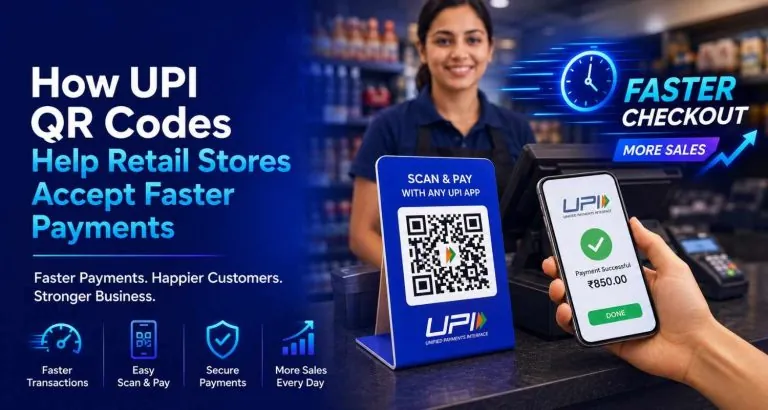
Retail businesses across India are changing the way they collect money from customers. Cash counters are slowly giving way to a small printed square that customers scan with their phones. This square, known as a UPI QR code, has become one of the simplest tools for speeding up checkout and reducing billing errors.
Shoppers today expect quick, contactless ways to pay. A long queue at the billing counter can push a customer to abandon a purchase entirely. This is where the growing use of UPI QR code in retail industry settings is making a visible difference, helping store owners close sales faster while keeping customers happy.
What Is a UPI QR Code
A UPI QR code is a scannable image that holds a merchant’s payment details, such as their UPI ID and bank account link. When a customer opens any UPI-enabled app and scans this code, the app automatically fills in the merchant’s payment information. The customer only needs to enter the amount and confirm the transaction with a UPI PIN.
There is no need to manually type account numbers or worry about typing mistakes. The entire process takes only a few seconds, which is far quicker than counting cash or waiting for card machine approval.
Why Retail Stores Are Adopting QR-Based Payments
Retail stores, from neighbourhood kirana shops to large supermarket chains, are adopting QR payments for several practical reasons.
Faster Billing at the Counter
Traditional payment methods often slow down billing. Cash needs counting and change, while cards require swiping and waiting for network approval. A QR code for UPI payment skips most of this. The customer scans, confirms, and the payment reflects almost instantly on the merchant’s phone or payment device.
Lower Dependency on Cash Handling
Handling cash brings its own set of problems, including theft risk, counting errors, and the cost of visiting a bank for deposits. QR-based UPI payments reduce the amount of physical cash a store needs to manage daily.
No Additional Hardware Required
Unlike card machines that require a POS terminal, a UPI QR code can simply be printed on paper or displayed as a static sticker at the billing counter. Some retailers also use digital displays connected to their billing software for a more professional look.
Instant Payment Confirmation
Most UPI apps send a sound notification and an SMS once payment is successful. This instant confirmation removes the guesswork that often comes with manual entries or delayed bank transfers.
How QR Payments Improve the Customer Experience
Customers value speed and convenience, especially during busy shopping hours. A smooth checkout experience often determines whether a buyer returns to the same store.
Reduces Waiting Time
Because scanning takes only a few seconds, customer queues move faster. This is particularly useful during peak hours, festive sales, or weekend rush.
Works Across Banks and Apps
A UPI QR code is not tied to one particular bank or app. Customers can use any UPI-supported application of their choice, whether it is a banking app or a third-party payment app. This flexibility makes the payment method accessible to a wide customer base.
Minimal Errors in Transactions
Manual entry of account details often leads to mistakes. Scanning a QR code removes this risk almost entirely, since the merchant details are encoded directly into the code.
Benefits for Store Owners
Retailers gain several operational advantages by switching to QR-based collections.
Simplified Daily Reconciliation
Digital payments automatically generate a record in the bank statement and the UPI app’s transaction history. This makes daily reconciliation far simpler compared to manually counting and recording cash sales.
Lower Transaction Costs
Most UPI transactions for retail merchants come with little to no processing fee, unlike card payments that often carry a percentage-based charge. This helps small retailers retain more of their margins.
Better Cash Flow Tracking
Owners can track sales in near real-time through their banking apps, helping them make quicker decisions about restocking and daily expenses.
Builds Trust With Tech-Savvy Shoppers
Many younger shoppers prefer not to carry cash at all. Offering a QR code for UPI payment option signals that a store is modern and convenient, which can influence repeat visits.
Practical Tips for Retailers Setting Up UPI QR Codes
Setting up a UPI QR code is a simple process, but a few practices can make it more effective.
- Display the QR code clearly at the billing counter where customers can scan it easily.
- Keep a backup printed copy in case the digital display malfunctions.
- Regularly check that the linked bank account is active to avoid failed transactions.
- Train staff to verify payment confirmation screens before completing the sale.
- Use static QR codes for fixed displays and dynamic QR codes when billing software auto-generates the amount.
The Growing Role of QR Payments in India’s Retail Landscape
The use of UPI QR code in retail industry operations is no longer limited to big cities. Small towns and rural markets are increasingly adopting this payment method because of its low cost and ease of use. Vegetable vendors, tea stalls, and local grocery stores now commonly display a QR code next to their billing area.
This widespread adoption reflects a larger shift toward a less cash-dependent retail economy. As internet access and smartphone usage continue to grow, QR-based payments are expected to become even more common across all types of retail outlets.
Conclusion
UPI QR codes have changed the way retail stores handle payments by making transactions faster, safer, and easier to track. From reducing queue times to cutting down on cash-handling risks, the benefits extend to both store owners and customers. As more retailers recognise the value of a simple QR code for UPI display at their counter, this payment method is set to remain a core part of everyday retail operations in India.
Frequently Asked Questions (FAQs)
1. Is a UPI QR code safe to use for retail payments?
Yes, UPI QR codes are encrypted and only contain the merchant’s payment details. Customers still need to confirm the transaction with their own UPI PIN, which adds a layer of security.
2. Can a UPI QR code work with any banking app?
Yes, a UPI QR code is interoperable, meaning customers can use any UPI-supported app from any bank to scan and complete the payment.
3. Do retailers need extra hardware to use UPI QR codes?
No additional hardware is required. A printed QR code or a basic digital display is enough for customers to scan and pay.
4. What is the difference between a static and dynamic UPI QR code?
A static QR code displays the same code for all transactions, requiring the customer to enter the amount manually. A dynamic QR code automatically includes the bill amount, usually generated through billing software.
5. Are there any charges for accepting UPI QR payments in retail stores?
Most UPI transactions for retail merchants are processed with minimal to no fees, making it a cost-effective option compared to card payment systems.