
Healthcare has always been information-intensive. Every patient interaction produces documents, instructions, or referrals, as well as follow-up needs, and managing this flow effectively directly impacts the quality of healthcare.
QR codes for healthcare aren’t an exception in this regard. It’s evolving into operational infrastructure, an easy and low-friction way to move crucial information between staff, systems, and patients, without adding additional administrative burden.
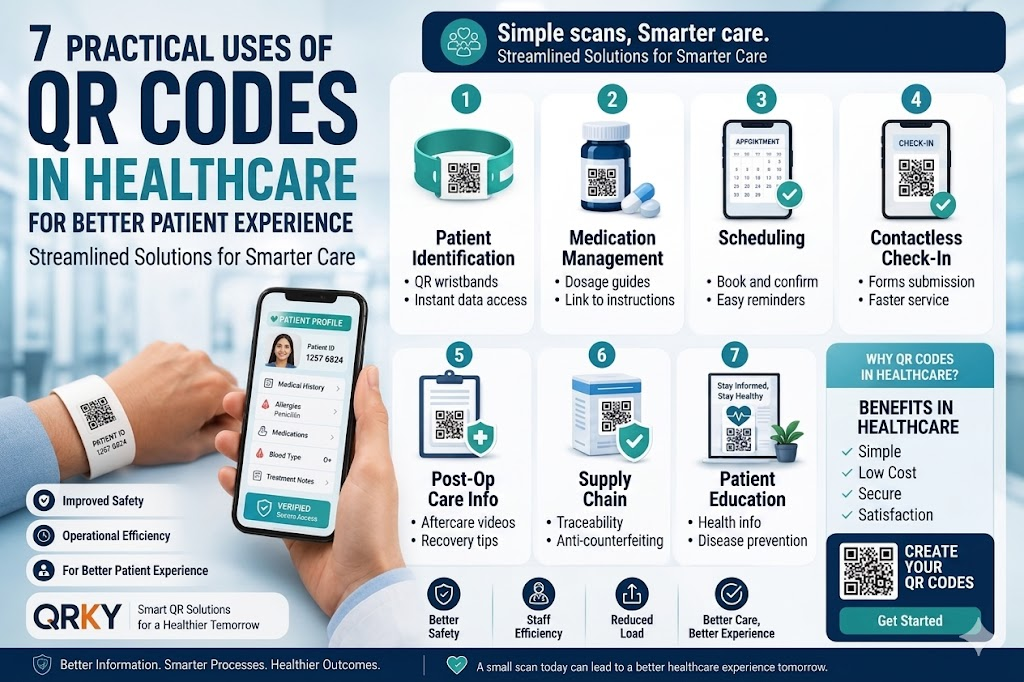
Here are seven examples of how a QR code for healthcare solutions is already making an impact.
1. Patient Identification and Record Access
Patients’ wristbands with QR codes provide medical staff with immediate access to the appropriate record during treatment. The scan will reveal medical history, allergies, treatment notes, and blood types — all with no manual entry, without paper records, and without the delay of searching through multiple systems. In fast-paced clinical environments, it’s not just a benefit; it’s an emergency safety measure.
The use of QR codes for patient identification reduces the risk of misidentification, a leading cause of errors in clinical practice worldwide.
2. Medication and Dosage Instructions
Discharge documentation is usually an insecure link within care continuity. Patients are discharged with instructions they don’t fully understand, which can lead to noncompliance, readmission, or potential complications. A QR code on a prescription label discharge form that links to precise, multilingual prescription instructions that include dosage schedules, adverse effects, and dietary restrictions provides patients with a reliable, easily accessible guide to the entire process of their treatment. This makes QR codes for information sharing highly effective in improving medication adherence and patient understanding.
3. Appointment Scheduling and Reminders
Inadequate appointments cost healthcare providers significant time and delay treatment. The health-related QR code on a doctor’s letter or referral card, or on notice boards in waiting areas that connect directly to an online scheduler, eliminates the inconvenience of a telephone call. Patients can schedule or cancel appointments in a matter of minutes, and the system records the confirmation on their behalf.
The integration of QR codes with appointment reminder systems, where the code links to a cancellation or confirmation page, reduces no-shows without increasing staff workload.
4. Contactless Check-In at Clinics and Hospitals
Physical waiting rooms are high-volume, high-contact environments. Check-in using QR codes allows patients to confirm their attendance, update their contact information, and complete the pre-appointment form from their own devices without waiting at the reception desk. It shifts administrative tasks to the patient’s fingertips, freeing reception staff to handle more complex interactions.
This use of a QR code for healthcare improves operational efficiency while reducing unnecessary physical contact in crowded clinical settings.
5. Information Sharing for Post-Procedure Care
Post-operative and post-procedure guidelines are crucial for recovery. However, printed brochures are often lost or not read. QR codes on wristbands, discharge summaries, or even a pharmacy bag could link to an organized aftercare guide that includes instructions for wound care and physiotherapy exercises, warning signs to look out for, and emergency contact information. Information is accessible at all times and can be easily shared with family caregivers, and may be updated when medical guidance changes.
This type of QR code for information sharing ensures patients and caregivers always have access to updated recovery instructions when they need them most.
6. Pharmaceutical Traceability and Anti-Counterfeiting
The quality of the pharmaceutical supply chain is a major global security concern. QR codes on the packaging of medicines, linked to batch records, manufacturing data, and chain-of-custody information, enable distributors, pharmacists, and customers to verify the product’s authenticity at any time. This is crucial in the market where counterfeit medicines have been identified as a potential danger.
The same QR code used to track healthcare traceability applies to implants, medical devices, and diagnostic instruments – all products whose specifications and provenance must be confirmed at the time of use.
7. Health Education in Waiting Areas
Waiting rooms offer a neglected chance to promote health. QR codes on notice boards and posters may link to specific educational content, prevention guides, vaccination information, and mental health information. Patients already in a health care environment are more open to this information. The scan rate in waiting areas is always more than in any other physical place.
Using a QR code for information sharing in waiting areas also helps healthcare providers distribute educational resources without increasing printing costs.
The Case for QR in Clinical and Administrative Settings
The pressure to increase throughput in healthcare facilities isn’t going to ease. Staff shortages, the increasing volume of patients, and the difficulty of coping with chronic diseases all point in the same direction. The administrative layer must be more efficient so that the clinical layer can function at its highest capacity. QR codes target a particular frequent inefficiency – the handoff of information. They solve it without requiring significant infrastructure changes.
Each use case is being implemented in clinics, hospitals, and pharmacy chains worldwide. The common thread isn’t the technology but what it can do: better information, more efficient processes, and a better patient experience that isn’t overwhelmed at times when patients are most vulnerable. This is a quality worth investing in.
QRKY offers flexible, trackable QR codes for use across digital, print, and packaging. There are no watermarks, no complicated setup, and full control over the destination. Check out qrky.ai to get started and create a QR code for healthcare touchpoints that will truly improve patients’ experience.
FAQs:
1. How can QRKY QR codes improve patient communication?
QRKY can help healthcare providers simplify communication by linking QR codes to appointment details, patient instructions, reports, forms, or emergency contacts. Creative QR designs also make healthcare materials easier to notice and access, improving convenience for patients and visitors.
2. Are QRKY QR codes suitable for hospitals and clinics?
Yes. Hospitals, clinics, diagnostic centers, and healthcare organizations can use QRKY QR codes for registrations, feedback forms, appointment booking, navigation assistance, and patient education materials. Customized QR designs also help maintain professional branding across healthcare communication.
3. Can QRKY QR codes reduce paperwork in healthcare?
Absolutely. QRKY QR codes can direct patients to digital forms, prescriptions, reports, insurance documents, or consent forms. This helps healthcare providers streamline administrative tasks, reduce manual paperwork, and improve efficiency while making processes simpler for patients.
4. Are QRKY QR codes secure for healthcare use?
QRKY focuses on creating functional and reliable QR experiences that can connect users directly to trusted digital destinations. Healthcare providers can use QRKY responsibly to share important information quickly while improving accessibility and reducing unnecessary physical interactions.
5. How do creative QR codes benefit healthcare branding?
Creative QR codes help healthcare organizations present a more modern and patient-friendly image. QRKY allows hospitals and clinics to create visually integrated QR designs that feel less technical and more approachable, improving both communication effectiveness and overall patient experience.